Atlassian Error 146 We Encountered Some Problems During Processing This Request Please Try Again
This browser is no longer supported.
Upgrade to Microsoft Edge to have advantage of the latest features, security updates, and technical support.
Troubleshoot Remote Process Telephone call (RPC) errors
You might see an RPC server unavailable error when connecting to Windows Management Instrumentation (WMI), SQL Server, during a remote connection, or for some Microsoft Management Console (MMC) snap-ins. The following image is an instance of an RPC error.

This bulletin is a usually encountered error bulletin in the networking earth and 1 tin can lose hope fast without trying to understand much, as to what is happening 'nether the hood'.
Before getting in to troubleshooting the *RPC server unavailable- error, permit's starting time sympathize basics about the error. There are a few of import terms to understand:
- Endpoint mapper – a service listening on the server, which guides customer apps to server apps by port and UUID.
- Tower – describes the RPC protocol, to allow the customer and server to negotiate a connection.
- Floor – the contents of a tower with specific data like ports, IP addresses, and identifiers.
- UUID – a well-known GUID that identifies the RPC application. The UUID is what yous use to see a specific kind of RPC application conversation, as there are likely to be many.
- Opnum – the identifier of a function that the customer wants the server to execute. It's but a hexadecimal number, but a good network analyzer volition translate the function for you. If neither knows, your application vendor must tell y'all.
- Port – the communication endpoints for the customer and server applications.
- Stub data – the information given to functions and information exchanged between the client and server. This data is the payload, the important part.
Annotation
A lot of the above data is used in troubleshooting, the almost important is the Dynamic RPC port number you become while talking to EPM.
How the connection works
Customer A wants to execute some functions or wants to make use of a service running on the remote server, will offset establish the connexion with the Remote Server by doing a 3-fashion handshake.
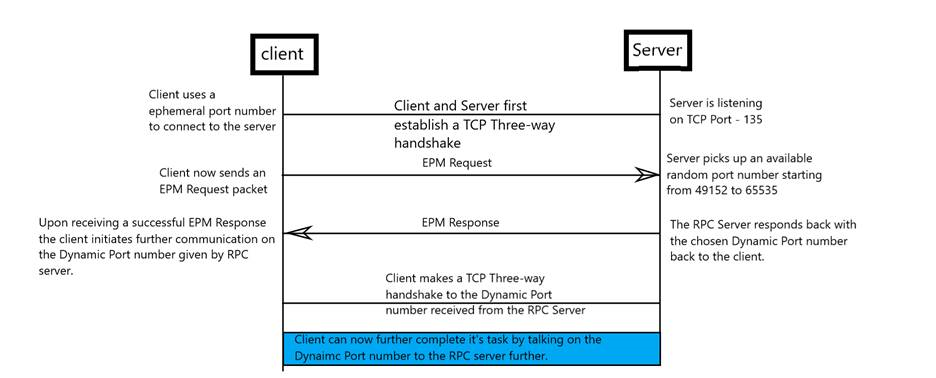
RPC ports can be given from a specific range equally well.
Configure RPC dynamic port allocation
Remote Procedure Call (RPC) dynamic port allocation is used by server applications and remote administration applications such as Dynamic Host Configuration Protocol (DHCP) Manager, Windows Cyberspace Proper noun Service (WINS) Manager, so on. RPC dynamic port allocation will instruct the RPC program to employ a particular random port in the range configured for TCP and UDP, based on the implementation of the operating system used.
Customers using firewalls may want to control which ports RPC is using so that their firewall router can be configured to forwards only these Transmission Control Protocol (UDP and TCP) ports. Many RPC servers in Windows let yous specify the server port in custom configuration items such every bit registry entries. When y'all tin can specify a defended server port, you know what traffic flows between the hosts across the firewall, and you can define what traffic is allowed in a more directed fashion.
As a server port, choose a port outside of the range you may desire to specify below. Y'all can find a comprehensive list of server ports that are used in Windows and major Microsoft products in the commodity Service overview and network port requirements for Windows. The article as well lists the RPC servers and which RPC servers tin can exist configured to employ custom server ports across the facilities the RPC runtime offers.
Some firewalls also allow for UUID filtering where information technology learns from an RPC Endpoint Mapper request for an RPC interface UUID. The response has the server port number, and a subsequent RPC Bind on this port is then allowed to pass.
With Registry Editor, you tin can modify the post-obit parameters for RPC. The RPC Port key values discussed below are all located in the post-obit key in the registry:
HKEY_LOCAL_MACHINE\Software\Microsoft\Rpc\Internet\ Entry name Information Type
Ports REG_MULTI_SZ
- Specifies a set of IP port ranges consisting of either all the ports bachelor from the Cyberspace or all the ports not available from the Internet. Each string represents a single port or an inclusive set of ports. For example, a unmarried port may exist represented past 5984, and a set of ports may exist represented by 5000-5100. If whatever entries are exterior the range of 0 to 65535, or if whatsoever string tin't be interpreted, the RPC runtime treats the unabridged configuration as invalid.
PortsInternetAvailable REG_SZ Y or N (non case-sensitive)
- If Y, the ports listed in the Ports key are all the Cyberspace-available ports on that computer. If N, the ports listed in the Ports key are all those ports that aren't Cyberspace-bachelor.
UseInternetPorts REG_SZ ) Y or N (not case-sensitive)
- Specifies the arrangement default policy.
- If Y, the processes using the default will be assigned ports from the fix of Cyberspace-available ports, as defined previously.
- If Northward, the processes using the default will be assigned ports from the fix of intranet-but ports.
Instance:
In this example, ports 5000 through 6000 inclusive take been arbitrarily selected to help illustrate how the new registry key can be configured. This example isn't a recommendation of a minimum number of ports needed for any detail system.
-
Add together the Internet key nether: HKEY_LOCAL_MACHINE\Software\Microsoft\Rpc
-
Nether the Internet primal, add the values "Ports" (MULTI_SZ), "PortsInternetAvailable" (REG_SZ), and "UseInternetPorts" (REG_SZ).
For case, the new registry key appears as follows: Ports: REG_MULTI_SZ: 5000-6000 PortsInternetAvailable: REG_SZ: Y UseInternetPorts: REG_SZ: Y
-
Restart the server. All applications that utilise RPC dynamic port allotment use ports 5000 through 6000, inclusive.
You should open up upwards a range of ports above port 5000. Port numbers below 5000 may already exist in apply by other applications and could crusade conflicts with your DCOM application(south). Furthermore, previous experience shows that a minimum of 100 ports should be opened, considering several arrangement services rely on these RPC ports to communicate with each other.
Note
The minimum number of ports required may differ from computer to computer. Computers with higher traffic may run into a port exhaustion situation if the RPC dynamic ports are restricted. Take this into consideration when restricting the port range.
Warning
If in that location is an error in the port configuration or there are insufficient ports in the pool, the Endpoint Mapper Service will not be able to register RPC servers with dynamic endpoints. When there is a configuration error, the error code volition be 87 (0x57) ERROR_INVALID_PARAMETER. This tin can touch Windows RPC servers as well, such as Netlogon. Information technology will log result 5820 in this case:
Log Name: System Source: NETLOGON Result ID: 5820 Level: Error Keywords: Classic Description: The Netlogon service could not add together the AuthZ RPC interface. The service was terminated. The following error occurred: 'The parameter is wrong.'
If you would like to practise a deep swoop as to how it works, meet RPC over IT/Pro.
Troubleshooting RPC error
PortQuery
The all-time affair to always troubleshoot RPC issues before even getting in to traces is past making employ of tools similar PortQry. Y'all tin quickly decide if you're able to make a connection by running the command:
Portqry.exe -n <ServerIP> -e 135 This command would give y'all much of the output to look for, but you should be looking for *ip_tcp- and the port number in the brackets, which tells whether you were successfully able to get a dynamic port from EPM and also brand a connection to it. If the higher up fails, you can typically first collecting simultaneous network traces. Something like this from the output of "PortQry":
Portqry.exe -n 169.254.0.ii -east 135 Partial output below:
Querying target system called: 169.254.0.2 Attempting to resolve IP address to a name... IP accost resolved to RPCServer.contoso.com querying... TCP port 135 (epmap service): LISTENING Using ephemeral source port Querying Endpoint Mapper Database... Server's response: UUID: d95afe70-a6d5-4259-822e-2c84da1ddb0d ncacn_ip_tcp:169.254.0.ten[49664]
The one in bold is the ephemeral port number that you made a connection to successfully.
Netsh
You can run the commands below to use Windows inbuilt netsh captures, to collect a simultaneous trace. Retrieve to execute the below on an "Admin CMD", it requires summit.
-
On the client
Netsh trace start scenario=netconnection capture=yeah tracefile=c:\client_nettrace.etl maxsize=512 overwrite=yes report=yep -
On the Server
Netsh trace start scenario=netconnection capture=yes tracefile=c:\server_nettrace.etl maxsize=512 overwrite=yeah report=aye
Now try to reproduce your issue from the client machine and as before long every bit yous experience the outcome has been reproduced, go ahead and stop the traces using the command
Netsh trace finish Open up the traces in Microsoft Network Monitor 3.4 or Message Analyzer and filter the trace for
-
Ipv4.address==<client-ip>andipv4.address==<server-ip>andtcp.port==135or onlytcp.port==135should aid. -
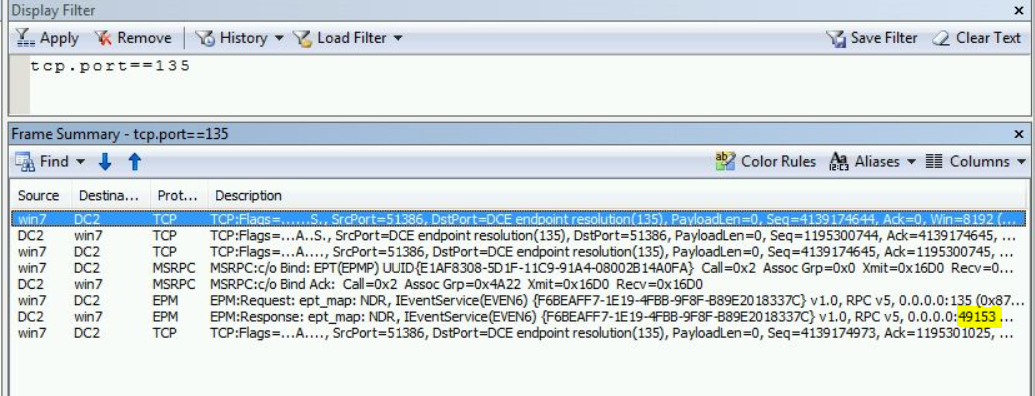
Expect for the "EPM" Protocol Under the "Protocol" column.
-
At present check if you're getting a response from the server. If you become a response, note the dynamic port number that you lot've been allocated to use.
-
Cheque if we're connecting successfully to this Dynamic port successfully.
-
The filter should be something like this:
tcp.port==<dynamic-port-allocated>andipv4.address==<server-ip>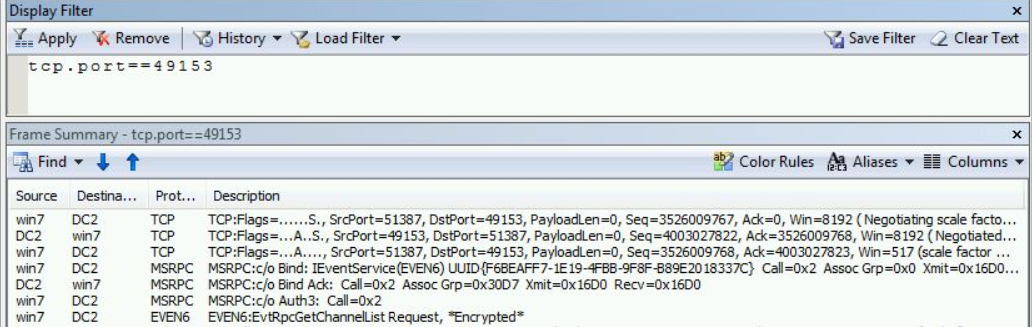
This filter should help you verify the connectivity and isolate if whatsoever network problems are seen.
Port non reachable
The nigh common reason why we would see the RPC server unavailable is when the dynamic port that the client tries to connect isn't reachable. The client side trace would so testify TCP SYN retransmits for the dynamic port.
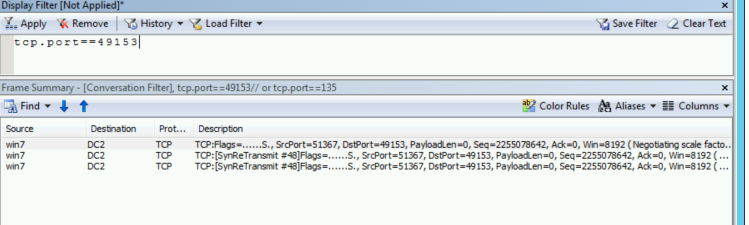
The port can't be reachable due to one of the following reasons:
- The dynamic port range is blocked on the firewall in the environment.
- A middle device is dropping the packets.
- The destination server is dropping the packets (WFP drop / NIC drop/ Filter commuter etc.).
Feedback
Submit and view feedback for
Source: https://docs.microsoft.com/en-us/windows/client-management/troubleshoot-tcpip-rpc-errors

Enregistrer un commentaire for "Atlassian Error 146 We Encountered Some Problems During Processing This Request Please Try Again"